
“It is easier to enhance creativity by changing conditions in the environment than by trying to make people think more creatively.” ~ Mihaly Csikszentmihalyi in Creativity: Flow and the Psychology of Discovery and Invention
You can’t make a cake without a cake pan.
All that delicious gooey batter needs something to hold it in place so the oven’s heat can work its magic.
Although the cake pan is rigid and unchanging, it makes transformation possible.
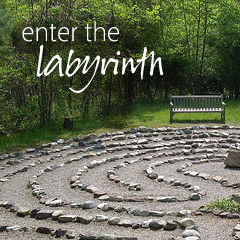
You cannot get lost in a labyrinth.
There is no wrong path. There are many twists and turns, leaps forward and doublings back, but you are always moving closer to the centre.
Once you enter, you can give yourself over to the path of the labyrinth ~ progress is inevitable as long as you keep walking.
“Conditions for creativity are to be puzzled; to concentrate; to accept conflict and tension; to be born everyday; to feel a sense of self.” ~ Erich Fromm
Our creative ideas, in their state of puzzlement before solidifying, need a structure to pour themselves into.
They need the structure of a discipline, with all of its tools and conventions developed over thousands of years.
The structure of a form or genre, dictating overall shape and essential ingredients.
Much of the required tension lies between the fluid, unformed nature of our inspiration, and the unyielding limits of the medium in which we work.
In the same way, our creative energy and impulses need a structure to channel themselves, so that the required concentration is brought to bear.
We need to build structures into our daily life that guarantee time and space for our art-making.
Physical and emotional structures that carry us along with little effort, so that we can exert ourselves inside the studio, not in getting there.
When we know who we are, and have the assurance that our structures will bear us up, there we find the courage to be born everyday, to start over with beginner’s mind.
The vulnerability of making art is held safely in the labyrinth.
Your ideally designed creative conditions will look different from mine and everyone else’s. There’s no blueprint to follow. But we do have the common principle, the Labyrinth, to guide us in our construction.
And to illustrate the principle, I’ll introduce you to a labyrinth in my own life.
The work of establishing a labyrinth comes at the beginning.
Shawn and I used to own a car, a trusty gray Honda Accord. Selling it required a few hours’ work: taking a photograph, posting it on Craigslist, negotiating with the buyer, and delivering the car to its new home.
A few more hours were invested in researching and signing up for a car-sharing network.
Then we sat back to reap the benefits.
Designing a labyrinth requires big-picture thinking.
We were able to sell our car because we live downtown and can get around without it. In fact, the possibility of living car-free was a big factor in us choosing our condo, even though we didn’t sell our car until two years after moving in.
We looked at the financial costs of car ownership, the hassles of care and maintenance and downtown parking, and decided that we were willing to do without the convenience. The environmental benefits were a bonus.
Once a labyrinth is in place, you can keep your head down and put one foot in front of the other.
We didn’t have to solve all the challenges of living car-free at once. We just needed to decide each day how we would get from one place to another: learning the bus schedules, finding the best bike routes, buying the right kind of winter boots.
We all know walking is good for us. When walking is one of several options ~ especially when it is a less convenient option ~ we have to make an effort to choose it every time. When walking is the only option, it happens effortlessly.
Even though a labyrinth will take us a long way, we can’t see very far ahead at any given time.
When we added kids to our family, people asked if we would be buying a car again. We didn’t know exactly what transporting kids would require of us. But because we were already in the car-free labyrinth, we planned to stay on that path.
And it led us to mei-tai carriers and double strollers, local playgroups and friends on every block.
A labyrinth itself is beautiful, and walking it brings us pleasure.
My life feels richer because I rarely drive anywhere. My body gets regular exercise. I notice and feel part of the city. Riding the bus is a communal activity. When we do rent a car some weekends, it’s a special treat to visit shops and parks and restaurants we couldn’t normally get to.
Even though we know where the centre is, a labyrinth changes us in ways we wouldn’t have expected.
I never would have thought that selling our car would have such a big effect on my creative life. But it has.
Whenever I walk, my mind immediately searches for a luscious question to resolve: what happens in the next scene of my novel? How will I begin my query letter? What will I blog about tomorrow? I do most of my planning and idea generation while I’m walking. And I don’t have to schedule these walks ~ they happen without fail.
The course of the labyrinth may not be easy, but its structure keeps us going.
Yes, there are days when I curse the winter’s slush that turns the trip to daycare into an obstacle course. Having a child tantrum loudly all the way home is not fun. It’s a hassle to make sure I have bus tickets. But the car-free conditions are established, and they stay in place even when the going is tough.
My only regret about living car-free is that we didn’t do it sooner.
What labyrinths come to mind in your own life? How have they affected your creative process?
Image courtesy of BotheredByBees



{ 7 comments… add one }